
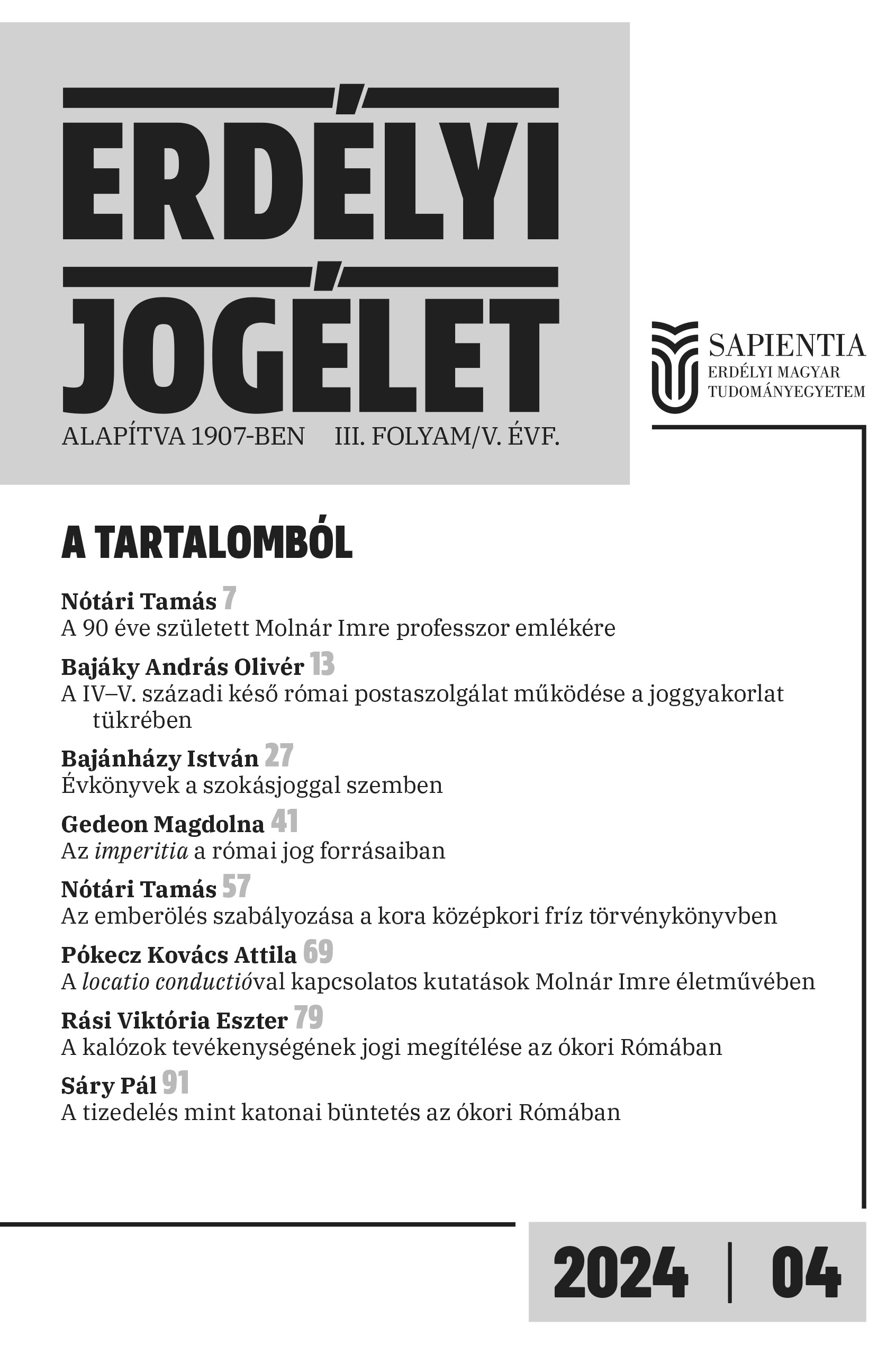
The Operation of the Late Roman Postal Service in the 4th–5th Centuries in the Light of Case Law
DOI:
https://doi.org/10.47745/ERJOG.2024.04.02Keywords:
cursus publicus, evectiones, history of Roman administration, magister officiorum, curiosiAbstract
During the Dominate period, the Roman postal and courier service (cursus publicus) was supervised by inspectors (curiosi), who were part of the secret agents, following the abolition of the praefectus vehiculorum. The management of the postal network was entrusted to a new chief court official, the magister officorum, from the reign of Constantius II. In the present study, in addition to a general description of the organization and operation of the
state post office, I will discuss two issues. Firstly, I aim to highlight the problem of the adjudication of infringement cases involving postal inspectors, the sources dealing with this issue providing for a joint procedure of magister officiorum and praefectus praetorio. The second problem relates to the right to issue a licence (evectiones) to use the post office. On this issue, I have come to the conclusion that no legal provision of a lasting nature was made until
the end of the 4th century.
Downloads
Published
How to Cite
Issue
Section
License
Copyright (c) 2025 Bajáky András Olivér

This work is licensed under a Creative Commons Attribution-NoDerivatives 4.0 International License.


