
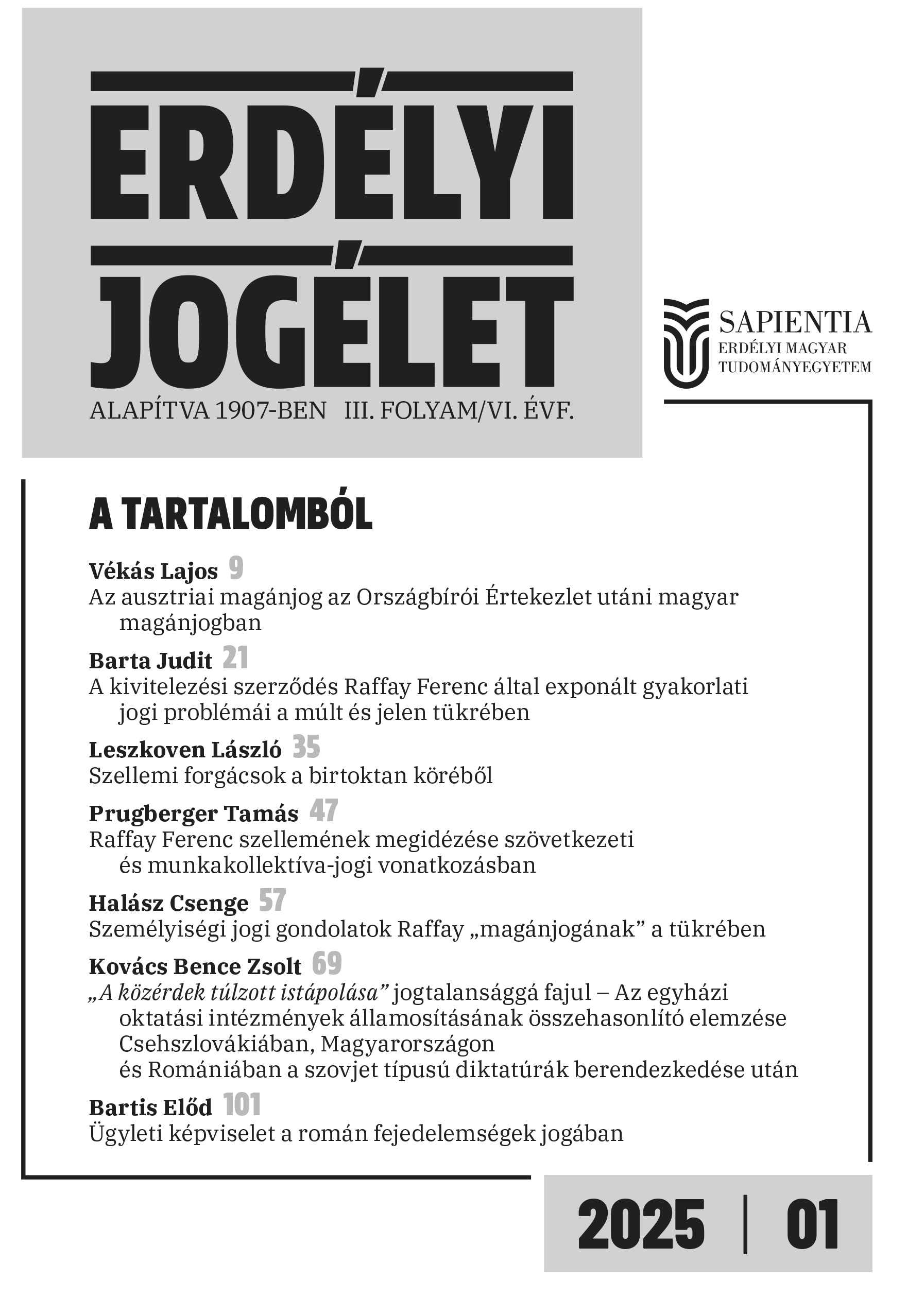
“The Excessive Patronage of Public Interest” Degenerates into Injustice – A Comparative Analysis of the Nationalization of Church-Run Educational Institutions in Czechoslovakia, Hungary, and Romania after the Establishment of Soviet-Type Dictatorships
DOI:
https://doi.org/10.47745/ERJOG.2025.01.07Keywords:
nationalization, expropriation, Soviet-type dictatorship, communist ideology, church-run educational institutionsAbstract
Between the two world wars, churches played a central role in maintaining most educational institutions in the region of Czechoslovakia, formerly part of Transleithania (the Kingdom of Hungary), throughout the entire territory of Hungary, and among ethnic minorities in Greater Romania. This situation changed fundamentally following the establishment of Soviet-type dictatorships, which led to the nationalization of church-run schools and kindergartens. This study explores the legal dimensions of this educational transformation across the three countries, focusing on the legislative frameworks that enabled nationalization. To this end, the concept of nationalization is defined in both its contemporary and historical meaning, the Marxist perspective on church-operated education is analysed, and the earlier Soviet policies that served as a blueprint for these changes are also reviewed.
Downloads
Published
How to Cite
Issue
Section
License
Copyright (c) 2025 Bence Zsolt Kovács

This work is licensed under a Creative Commons Attribution-NoDerivatives 4.0 International License.


