
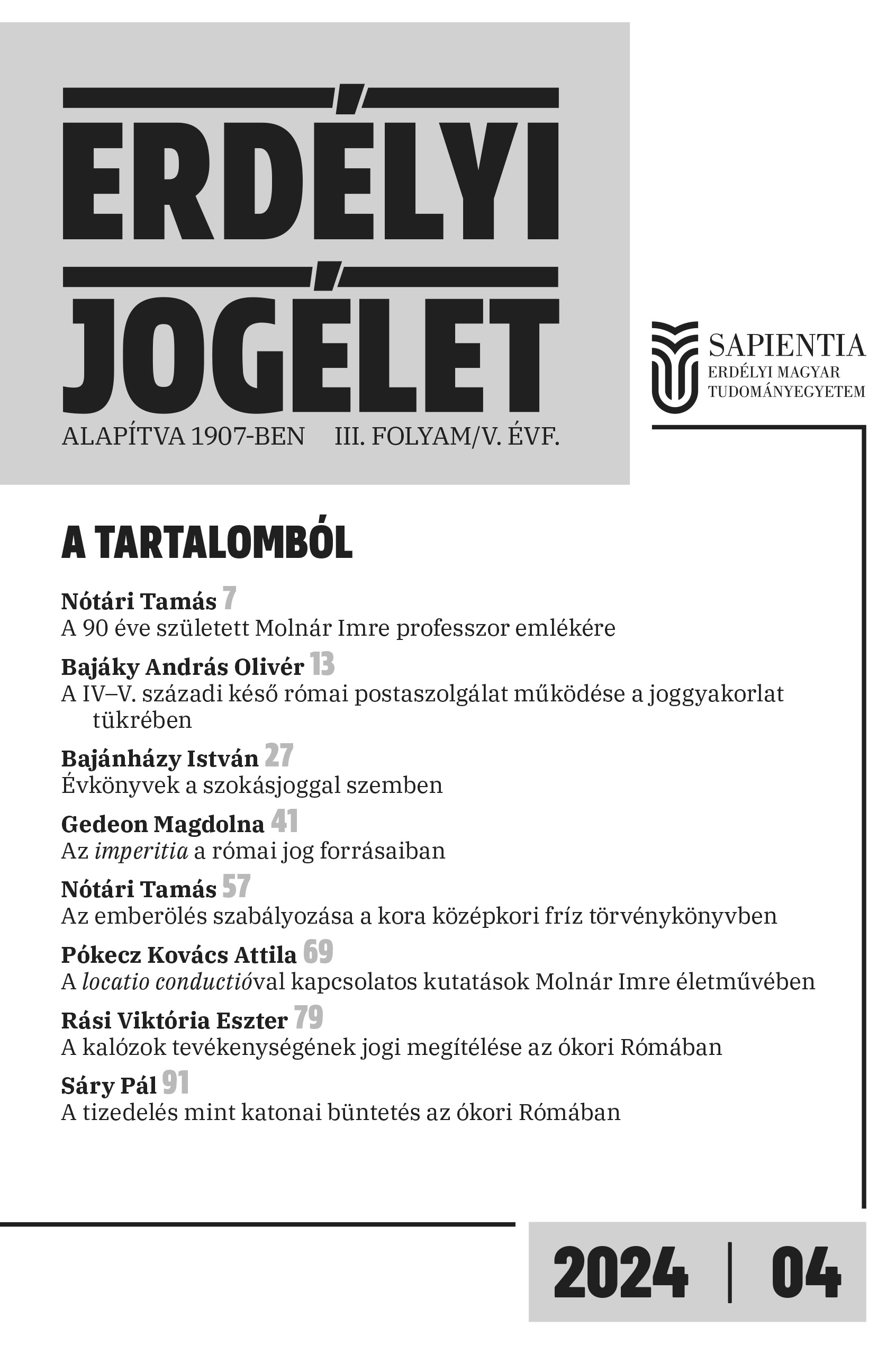
The Regulation of Manslaughter in the Early Medieval Frisian Code
DOI:
https://doi.org/10.47745/ERJOG.2024.04.05Keywords:
Lex Frisionum, Charlemagne, early medieval legal history, German criminal lawAbstract
Lex Frisionum belongs to the “third generation” of Germanic law, i.e. the collections which, such as Lex Saxonum and Lex Thuringorum, were written down on the orders of Charlemagne. The collection was probably presented to the Emperor at the imperial assembly in Aachen in 802, but in its surviving form it never became a source of law that could be applied in practice. The collection is strongly penal in its approach, and, despite the inconsistencies in the system of sanctions, it summarizes the customary law of Frisia (with Alemannic and Frankish elements) in a relatively coherent system. The regulation of offences against life, which the study will turn to (after clarifying the dating and source of Lex Frisionum), allows valuable conclusions to be drawn from a legal-historical point of view, not only with regard to the “special” part of the offence but also with regard to certain “general” parts (relating to the offence, participation, intentionality, negligence, and the grounds for exclusion of wrongdoing).
Downloads
Published
How to Cite
Issue
Section
License
Copyright (c) 2025 Nótári Tamás

This work is licensed under a Creative Commons Attribution-NoDerivatives 4.0 International License.


