
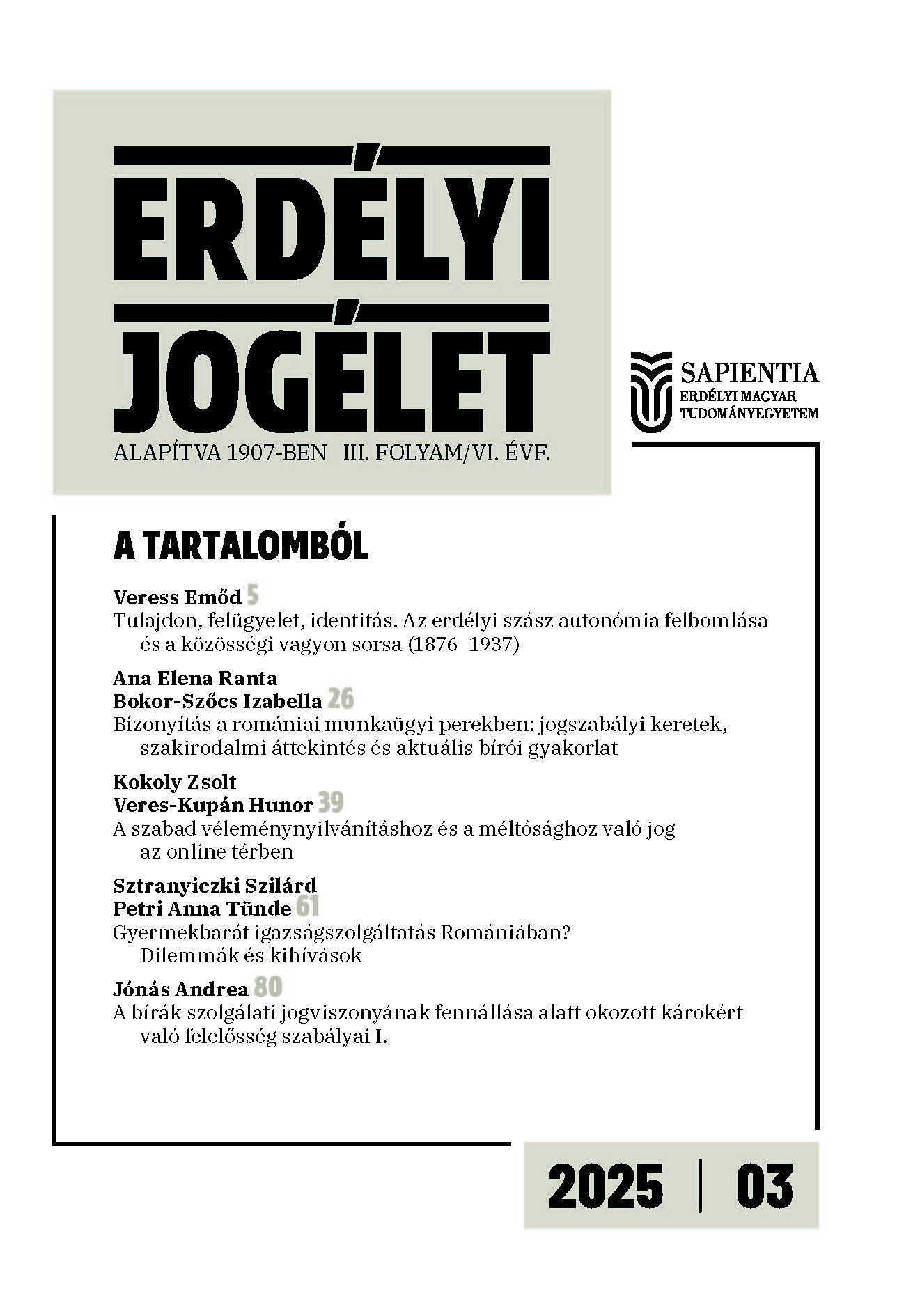
Property, Oversight, Identity: The Dissolution of Transylvanian Saxon Autonomy and the Fate of Communal Property (1876–1937)
DOI:
https://doi.org/10.47745/ERJOG.2025.03.01Keywords:
Transylvanian Saxons, Universitas Saxonum, autonomy dismantling (1876), communal property, agrarian reform (1921), 1937 dissolutionAbstract
The study follows the dismantling of Transylvanian Saxon autonomy from the 1876 county reform to the 1937 dissolution of the Saxon University, foregrounding property law. It shows how Act XXXIII of 1876 integrated the Saxon Seats and the Königsboden into counties, while Act XII of 1876 recast the Universitas Saxonum as a government-supervised cultural estate manager. The analysis reconstructs the legal mechanics that narrowed municipal and corporate control over communal assets and re-channelled governance through ministerial oversight. After the 1918–1919 change of sovereignty and Transylvania’s incorporation into Romania, the 1921 agrarian reform further reduced the asset base and room for self-government. The Romanian decree of 1937 then partitioned the remaining estate between the Evangelical Church and a Romanian cultural foundation, closing also the period of limited cultural self-administration.
Downloads
Published
How to Cite
Issue
Section
License
Copyright (c) 2026 Emőd Veress

This work is licensed under a Creative Commons Attribution-NoDerivatives 4.0 International License.


